
Unlock B2C2B with Open AI, Notion, and ElevenLabs
How product-led growth drives business adoption through customer advocacy

I grew up learning, reading, and working with consumer businesses. As an extrovert who enjoys working with people and observing human behaviors, I find B2C relatively natural. In 2019, about the same time I discovered venture capital, I came across more B2B investment opportunities. Since then, I have been brought into the world of B2B investing, and I've had a passion for companies at the intersection between B2B and B2C. In most cases, we categorize startups as B2B or B2C. I think sometimes the line gets a little blurry. As one can imagine, every consumer business would love to secure business customers, and every B2B business would love to enjoy quicker acquisitions of consumers. Organizations are made up of people, and people are the building blocks of organizations.
If you are selling to an enterprise, the average sales cycle is about 5 to 8 months, though it can go even further depending on factors like industry, the complexity of the product, the size of the deal, and the internal processes of an organization. It can take longer for healthcare, gov tech, and EdTech companies. Fortunately, the best part about selling to enterprises is the high retention - they don't onboard easily, but when they do, they tend to stick around.
B2C is the opposite. It can be easy to acquire customers and even quicker for free users. Yet, the churn can be staggering. Think about this: if a customer can discover a product through an ad and get onboard quickly, what's preventing them from leaving, given there's practically no switching cost early on? There's always someone offering better prices, newer features, higher discounts, and more free swags. This brings me to think about the best-case scenario: how can we get the best of both worlds?
What is B2C2B?
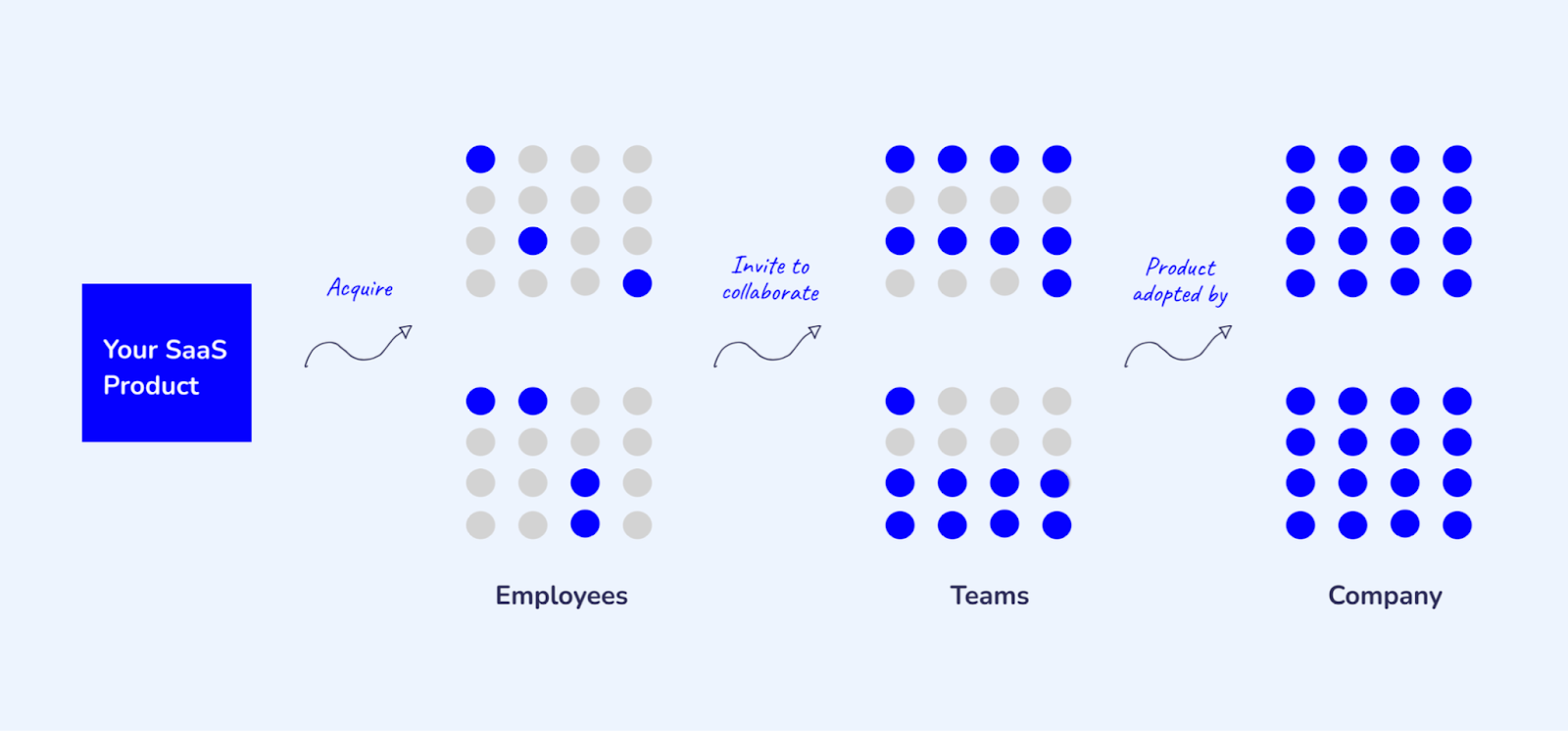
Source: Webflow, “The B2C2B Growth Model: Landing & Expanding Your SaaS”
As the name suggests, B2C2B stands for Business-to-Consumer-to-Business. How it works is that a company initially sells its products or services directly to individual consumers. They are likely employees of organizations, who then introduce these offerings to businesses. In this model, the consumer becomes a POC/ conduit for reaching businesses.
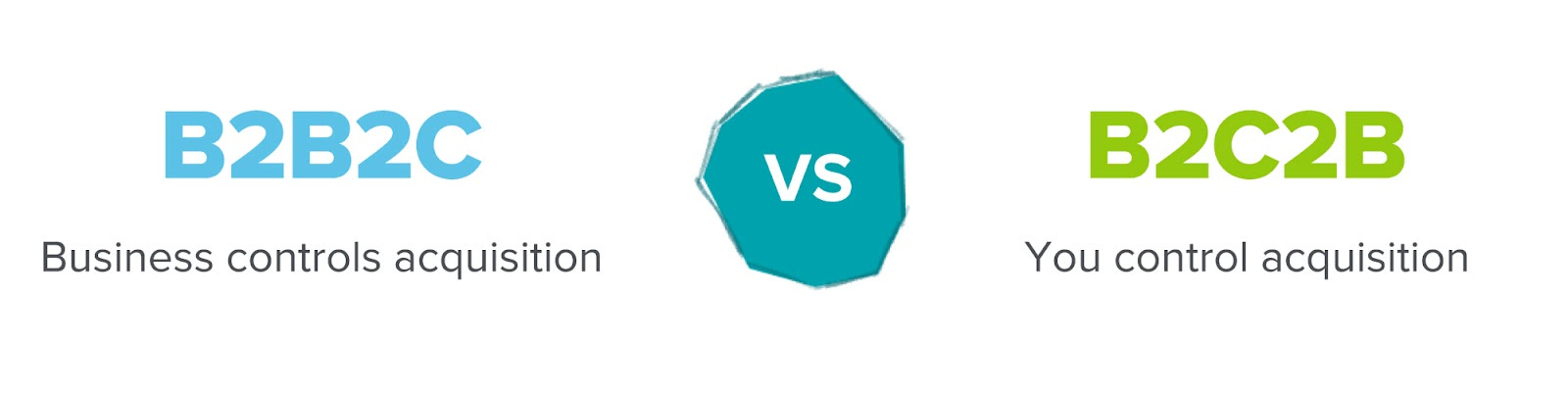
Source: Andreessen Horowitz, “B2C2B in Digital Health: A Founder’s Playbook” (12/1/21)
The B2C2B approach is increasingly popular for companies looking to bridge the gap between consumer and business segments. Here are some potential benefits that make B2C2B compelling.
User adoption
B2C2B allows for quicker user acquisition by leveraging consumers as advocates who promote the product internally to a business level. This organic approach can speed up adoption as businesses are more open/ more likely to trust recommendations from their own employees or trusted users. This also reduces the time and effort needed for traditional B2B marketing and sales. Think about this, one can acquire B2B customers with potentially strong retention at a much quicker speed.
Market Penetration & Network Effect
By initially focusing on consumers, companies can quickly build a user base and gather feedback to refine their products. As the product gains traction among individual users, it gradually spreads across word-of-mouth and internal recommendations. The B2C2B model can also create an indirect network effect: as more consumers adopt and advocate for the product within their workplaces, business adoption accelerates. This enhances the product's value and reputation, which drives broader adoption across both consumer and business segments.
Trust and Credibility
In venture and broader business contexts, a warm introduction can be a powerful way to build trust in a product. Think about it: how many of you started using a new app based on recommendations from friends, family, or colleagues? It's challenging to discover a new app and even harder to trust and adopt it. If internal employees see value in a product they've tried and tested, there's a higher likelihood that the product will be introduced at a business level with credibility.
Feedback Loop
Everyone wants to build a product that customers love. The biggest challenge is how often we ask for user feedback and how often users proactively provide it. For consumer-facing companies, gathering feedback can be easier than it is for B2B companies. By giving access to consumers, you create a channel for gathering immediate feedback and suggestions from users. Consumers are often more comfortable sharing how they truly feel, and sometimes even harsh feedback, without pressure from organizations. A good example of this is Google and Yelp reviews - do you feel pressured to write an honest review?
Risks of B2C2B
While the B2C2B model has major advantages, it comes with potential risks. It's important to evaluate existing resources, market focus, and readiness to support both consumer and business customers.
Resource Strain
A good number of founders I've talked to wish to raise to bring on more people. "We have a huge pipeline but don't have the capacity to onboard customers." Supporting both consumer and business customers requires a strong and holistic set of resources, from customer support to product development. Smaller companies or those with limited resources may struggle to meet the needs of both segments, which can lead to operational inefficiencies. If you want to acquire B2B customers yet do not have the infrastructure ready, leveraging B2C2B can impose a risk - both on a technical and a reputational level. Think about this: when consumers are very happy with the product, companies are more willing to get on board; if you are short on tech stack or human resources like customer support, it can hinder the sales and onboarding process. This not only looks bad on your end but also creates friction for businesses that are getting ready to use your product.
Uncertainty of outcome
I remember when AI scribe/ transcription software first became viral, both my lawyer friends and finance professional friends expressed strong interest in transcribing meeting notes. They bring this idea and the product back to the team, yet not everyone gets the green light from the company. For instance, for a smaller law firm, using transcription software to record and transcribe calls could be acceptable, yet for a large investment bank, it's not easy to get a yes. My friend has no idea who to talk to when proposing transcription software. In addition, there are compliance steps to go through. Introducing a product from consumers to corporations is a lot more challenging. At the end of the day, every GTM is an investment; no one knows exactly if it will pay off.
Lack of focus
Most companies were built with the thesis that you should stay laser-focused on what you do. This is the same for any success - athletes, Youtubers, entrepreneurs, and others. Staying focused is extremely important. When leveraging B2C2B, your focus could be affected by the constant feedback and potentially inconsistent buyer profiles. If you have been receiving traction from a specific vertical, should you wholeheartedly focus on it and pivot into a vertical software company?
Who should leverage B2C2B?
I can't speak for everyone, but based on my observation, it is most likely horizontal software providers, companies with strong consumer appeal, and companies selling both infrastructure-layer and application-layer products. If you're providing a product that acts both as an infrastructure layer and application layer, there's a huge potential to go B2C2B. Let's take Open AI as an example.
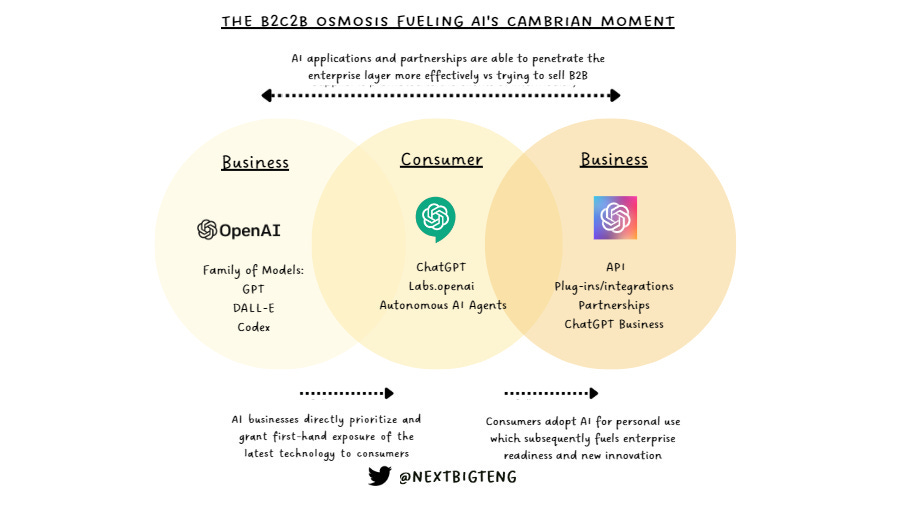

OpenAI
Infrastructure Layer
OpenAI offers foundational AI technologies that serve as the underlying infrastructure for various applications. These models power everything from chatbots to content-generation applications.
Application Layer
Beyond providing the infrastructure, OpenAI also develops end-user applications like ChatGPT, which are directly consumer facing. These applications make it easier for consumers to see the value and potential of AI in their daily lives.
OpenAI's strategy aligns with the B2C2B model - consumers use applications like ChatGPT to become familiar with the capabilities of AI in the process and then advocate for these tools within their organizations. As a result, businesses are introduced to OpenAI's capabilities through their employees, furthering adoption on a corporate level and this could be a direct use of OpenAI at the application layer or infrastructure layer. For instance, a content marketer using ChatGPT for personal projects may introduce it to the broader marketing team at work, and the business can then explore more AI applications like data analysis and content generation at scale. This can speed up the business' adoption of OpenAI's infrastructure to develop custom AI solutions.
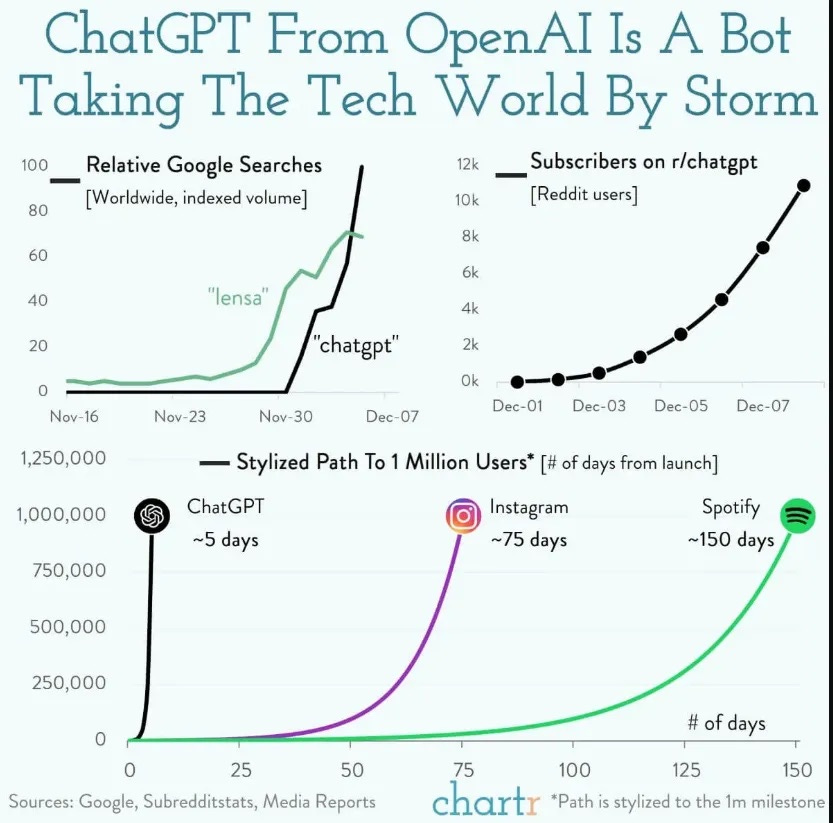
Source: Medium, “Exploration of ChatGPT and the Future of Generation AI” by Rushd Auwaiz (1/12/23)
If we look at the timeline, initially, OpenAI engaged consumers with products like ChatGPT, which quickly gained massive user adoption after its release in late 2022. By allowing individuals to experience AI in a user-friendly way, OpenAI built a strong consumer base. As these users found value in the technology, they began advocating for its use in 2023, becoming frequent users of tools like ChatGPT to maximize productivity at work. This consumer-driven approach led to broader business adoption by mid to late 2023, with companies increasingly integrating OpenAI's API and GPT models into their business operations. This organic growth strategy not only expanded OpenAI's market reach but also solidified its position as a key player in AI through both consumer and enterprise channels.
When does B2C2B not work?
The B2C2B model may not be suitable for companies whose products or services are strictly enterprise-focused, highly specialized, or require direct sales efforts to decision-makers within businesses. Also, companies that offer products with a steep learning curve, complex integrations, or that don't naturally lend themselves to consumer advocacy within organizations might struggle with this approach. For these companies, a direct B2B model, focusing on targeted sales and marketing efforts, may be more effective. Here are a few examples of when and how B2C2B may not be a great GTM.
Distinct product offerings for businesses and consumers - If you're offering two different products for consumers and enterprise customers, B2C2B may not be the most suitable. Having consumer recognition doesn't translate into business conviction.
Limited tech stack & teams - again, when you have limited resources, stay focused and lean. B2C2B might not be the right step during this phase.
Pure enterprise software - these companies position themselves as providers of comprehensive, scalable solutions for large enterprises. Their products are complex and tailored for business needs, requiring detailed customization and integration.
Niche markets - companies operating in very specialized or niche markets where the end-users are not typically consumers (e.g., industrial equipment, medical devices) may not benefit from the B2C2B approach, as there's little overlap between consumer and business needs.
Unique brand positioning - If you're building a luxury product, it helps to have conscious consumption operating at the consumer level. If you want very few people to have it, it makes sense to keep it exclusive and quiet by only operating at the consumer level.
How has AI changed the game?
I've observed a distinct difference between how consumers adopt AI and how B2B, especially enterprises, adopt it. At a consumer level, it's much easier to learn about a product through word-of-mouth and marketing. With fast sign-ups, consumers can see the instant results of an AI application. Many enterprises work with consultants or existing software providers offering additional AI products. In terms of how AI products get introduced through B2C2B, I think currently there is a gap. This could be a combination of compliance, security, or how AI applications were built - some are well suited for consumers, and others are hyper-targeted towards businesses.
Notion

Source: Community Inc, “Community Everywhere: Notion” by Gareth Wilson
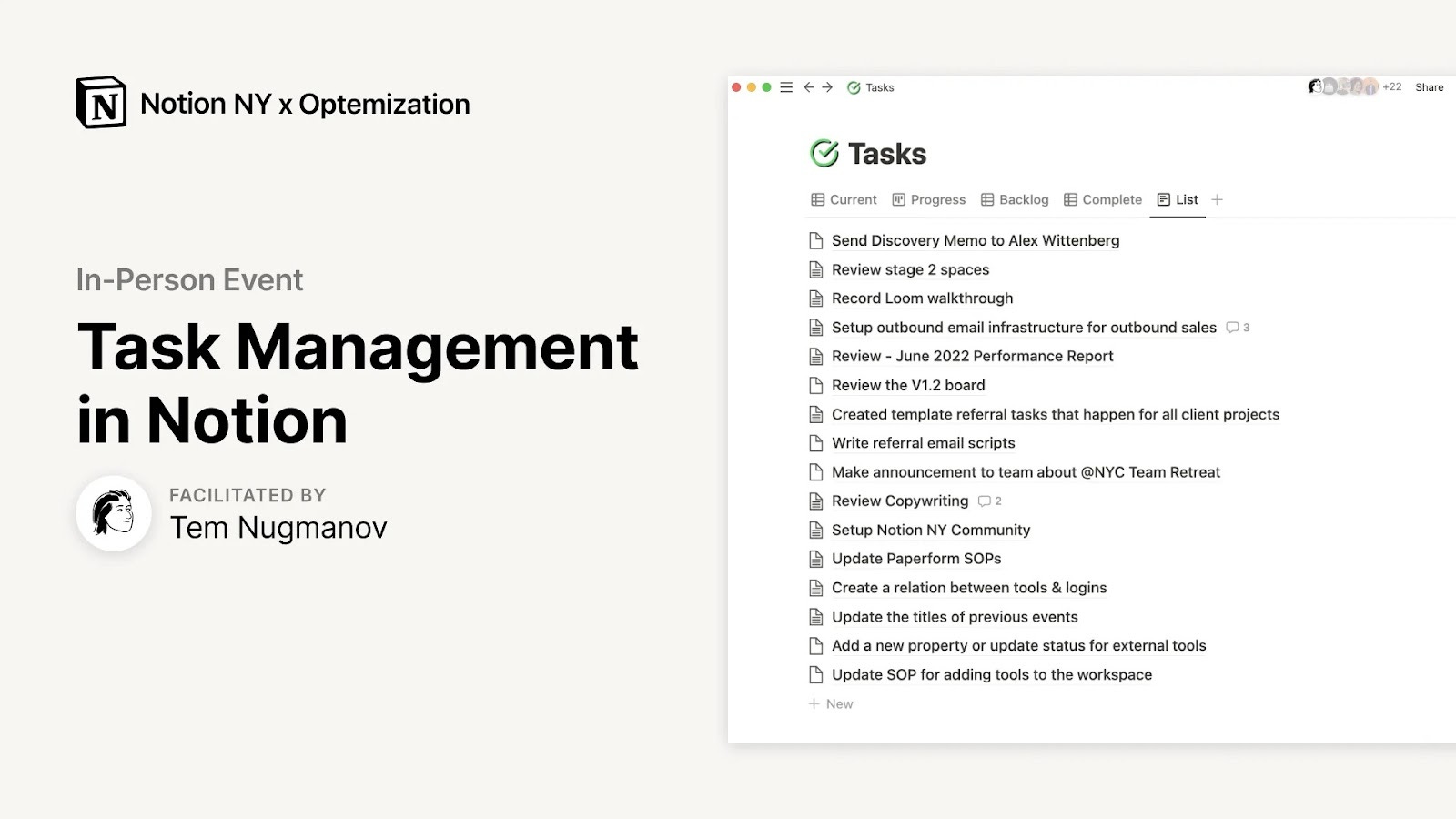
Source: Reddit, “Two Upcoming Notion Meetups in New York City” (8/6/22)
Notion is a productivity tool that offers note-taking, task management, and collaboration features. When I think of Notion, I always think of communities. In fact, my friend Tem has been a Notion consultant and advocate for years. As early as 2019, he started leading community sessions in NYC. Individual users, founders, solopreneurs, and tech enthusiasts would join his session to learn about productivity and Notion. By being community-driven, Notion has quickly gained a dedicated user base despite operating in a highly competitive market. Needless to say, Notion is a great example of the B2C2B model in action.
Source: Community Inc, “Community Everywhere: Notion” by Gareth Wilson
Founded in 2013, Notion's initial goal was to empower individuals to create their workflows with customizable building blocks. However, between 2014 and 2017, user feedback showed that most people wanted simpler tools that were easy to use, not something they had to build themselves. The Notion team then introduced templates in 2016, which enabled users to get started without having to create everything from scratch.
By 2017, Notion launched a straightforward note-taking and organizational tool for individual users. In early 2018, the team added a general-purpose database, which allowed users to manage all kinds of information in one place. As more people discovered and became familiar with Notion's capabilities, they began sharing their templates and workflows with friends and co-workers.
By 2019, Notion started catching on with teams and organizations by adding features like collaboration tools and team accounts, positioning itself as a go-to product for businesses. The COVID-19 pandemic in 2020 further boosted Notion's growth. Today, Notion continues to evolve and adds AI to optimize productivity. By starting with individual users and building a strong community, Notion made a natural transition into the business world, eventually becoming a powerful tool for both personal and professional use.
Timeline and Story of Notion's B2C2B Strategy. Source: Unusual Ventures, “Notion: Product-Market Fit” (2/9/24)
ElevenLabs
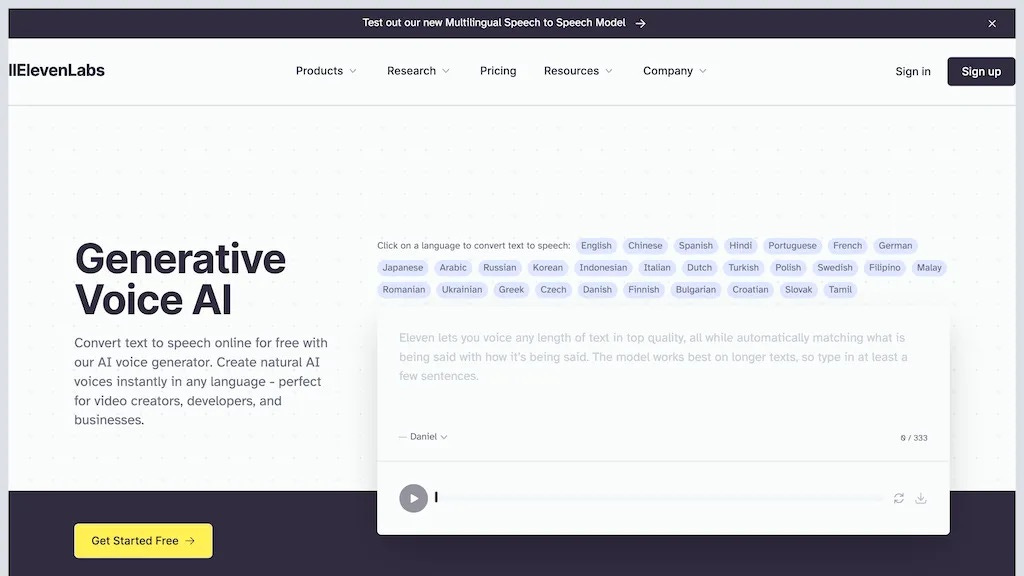
Source: Top AI Tools, “ElevenLabs”
For context, ElevenLabs is an AI-powered Text-to-Speech and Voice Generation platform that supports thousands of voices across 32 languages. When I first came across ElevenLabs in February of 2023, I did what everyone would do - trying the product on the home page, switching speakers and accents. As fun as it seems, I start asking myself, what do I do with it? How do they monetize? With most text to speech/ speech to text companies, many can quickly acquire a massive user base. But what about conversion and retention? What are daily use cases that prompt a user to pay for a monthly subscription? How can that happen at a business level?
Later that year, I was lucky to run into Mati in person. We had a really great conversation around use cases, customers and roadmaps. This was when I first got introduced to the idea of B2C2B. Letting users try the product, bringing it up to a corporate level, and securing business customers. Leveraging individual consumers as a key channel for business adoption. This approach supports both customer acquisition and retention.
Some of the initial users can be individual content creators, podcasters, and independent developers by offering user-friendly voice synthesis tools. Given the quality of the product, these consumers then became advocates for the product. As these consumers began using ElevenLabs’ technology in their projects, they naturally introduced it to businesses, such as media companies and content departments. This grassroots approach helps with business adoption without the need for heavy B2B marketing efforts. As for retention, there are text-to-speech consumer products in the market, and I think it’s getting crowded overtime. ElevenLabs has a huge advantage of providing both infrastructure and application layers to secure B2B and B2C customers. For example, businesses that adopted ElevenLabs’ technology often moved from consumer-level plans to enterprise licenses, having bulk usage, B2B customization, and API integrations. One can build a product by wrapping around text-to-speech infrastructure like ElevenLabs and compete with it by investing heavily in GTM. I think ElevenLabs remains competitive by being both the infrastructure and application layers, leveraging the B2C2B approach which aligns perfectly with the product offerings.
Disclaimer: These are my personal thoughts and opinions, independent of any organizations with which I am affiliated. This content is for informational purposes only and does not constitute investment advice or a recommendation to buy or sell any securities or financial instruments.
Nice!